

Importing from China works best when you treat it as a controlled process—not a search for the lowest unit price. A reliable order starts with a clear product brief, continues through supplier verification and quality checkpoints, and finishes with a shipping plan based on total landed cost.
To import from China, define the product and destination requirements, shortlist and verify suppliers, compare like-for-like quotations, approve a production sample, confirm compliance, place a protected order, inspect the goods, and arrange customs and shipping. For a first commercial order, use a customs broker or freight forwarder and never begin production before the specification and quality standard are written down.
1. Define the product and target landed cost
Before contacting wholesale suppliers in China, turn your idea into a buying brief. A supplier cannot quote accurately from a product name alone. Two items that look similar can have different materials, dimensions, finishes, safety requirements, packaging costs and failure rates.
Your initial request should include:
- Reference photos, a link, drawing or existing sample
- Material, dimensions, color and performance requirements
- Estimated order quantity and expected repeat volume
- Logo, private-label and retail-packaging requirements
- Destination country and intended sales channel
- Required test reports, certifications or labeling
- Target delivery date and acceptable price range
Set a target landed cost, not only a target factory price. Landed cost can include the unit price, tooling, packaging, testing, inspection, inland transport in China, export handling, international freight, insurance, customs duty, broker fees and final delivery. A cheaper quotation can become the most expensive option after rework, high freight volume or compliance problems.
2. Find the right type of supplier
China has factories, trading companies, wholesalers and specialist manufacturers. The best choice depends on the product and order. A factory may offer deeper customization, while a capable trading company can be useful when a project combines several categories or requires lower quantities.
Build a shortlist instead of selecting the first supplier that replies. Search by the product's material, manufacturing process and application—not just the retail name. For example, a request for a stainless-steel bottle becomes more precise when it includes capacity, steel grade, lid material, insulation performance, finish and packaging.
A China sourcing agent can help translate a commercial idea into supplier-ready specifications, search beyond one marketplace and compare options on the same basis.
3. Compare quotations correctly
Do not compare quotations until every supplier is pricing the same specification and trade terms. Ask each shortlisted supplier to separate the cost elements and confirm what is included.
| Quote item | What to confirm |
|---|---|
| Product | Material, dimensions, components, finish and tolerances |
| MOQ | Minimum per model, color, logo and packaging version |
| Price | Currency, Incoterm, validity period and quantity tier |
| Tooling | Mold, printing plate or setup charges and ownership |
| Packaging | Unit pack, inserts, master carton and barcode work |
| Lead time | Sample time, production time and start point |
| Quality | Inspection standard, defect limits and remedy process |
A clear comparison often removes the apparent price gap. One supplier may exclude packaging, another may quote a lighter material, and a third may assume a much larger MOQ. Requesting a structured quotation makes those differences visible.
4. Verify the supplier before paying
A polished storefront is not proof of manufacturing capability. Verify the legal company name, business registration, bank beneficiary, factory address and the supplier's experience with your product. The company receiving payment should have a clear relationship to the company named in the agreement and quotation.
For a higher-risk or custom order, add a live video walkthrough or factory audit. Look for relevant production equipment, incoming-material control, in-process inspection, finished-goods testing and traceable production records. Ask for recent reports that match the exact product and market; a certificate for a different model is not evidence for yours.
5. Approve samples and lock the specification
A sample is useful only when it becomes a reference for mass production. Record its material, measurements, color, function, logo position, packaging and any accepted variation. Keep one approved sample and have the supplier retain another.
For OEM or private-label products, confirm artwork versions, color codes, print method, barcode placement, carton marks and manual language before production. If a change is agreed after the sample, update the written specification. Messages scattered across chat applications are easy to miss during production.

6. Check compliance before production
The importer is responsible for understanding the rules in the destination market. Requirements vary by product and can involve product safety, electrical standards, chemicals, food contact, cosmetics, medical claims, energy efficiency, labeling or intellectual property. Confirm them before paying for tooling or mass production.
For U.S.-bound goods, identify the likely Harmonized Tariff Schedule classification using the official USITC tariff database and confirm the final classification and entry plan with a licensed customs broker. U.S. Customs and Border Protection also states that imported articles generally need English country-of-origin marking, subject to product-specific exceptions.
Regulated consumer products may require testing and a certificate. The U.S. Consumer Product Safety Commission explains that manufacturers or importers of covered general-use products must issue a General Certificate of Conformity based on applicable testing. As of July 8, 2026, certificate data for imported consumer products subject to CPSC certification must generally be filed electronically under the agency's eFiling requirements.
7. Control production and quality
Quality control should begin before the finished goods are packed. For custom products, confirm raw materials and a pre-production sample. During production, check critical dimensions, colors and functions early enough for correction. Before the balance payment or shipment, inspect a representative random sample against the approved specification.
A useful inspection checklist defines critical, major and minor defects; the sampling method; functional tests; packaging checks; carton quantities; labels; and photo evidence. The goal is not to “check quality” in general—it is to decide whether the shipment matches the agreed standard.
If defects are found, document the quantity and severity, then agree on rework, replacement, sorting or another remedy before release. A clear remedy process is more valuable than a vague promise that the factory will “pay attention next time.”
8. Consolidate orders from multiple suppliers
Online stores and physical retailers often buy several product groups in one launch. If each factory ships separately, local pickup charges, export paperwork and minimum freight fees can multiply. A consolidation warehouse can receive the orders, count cartons, inspect outer packaging, check shipping marks, combine documentation and build one shipment.
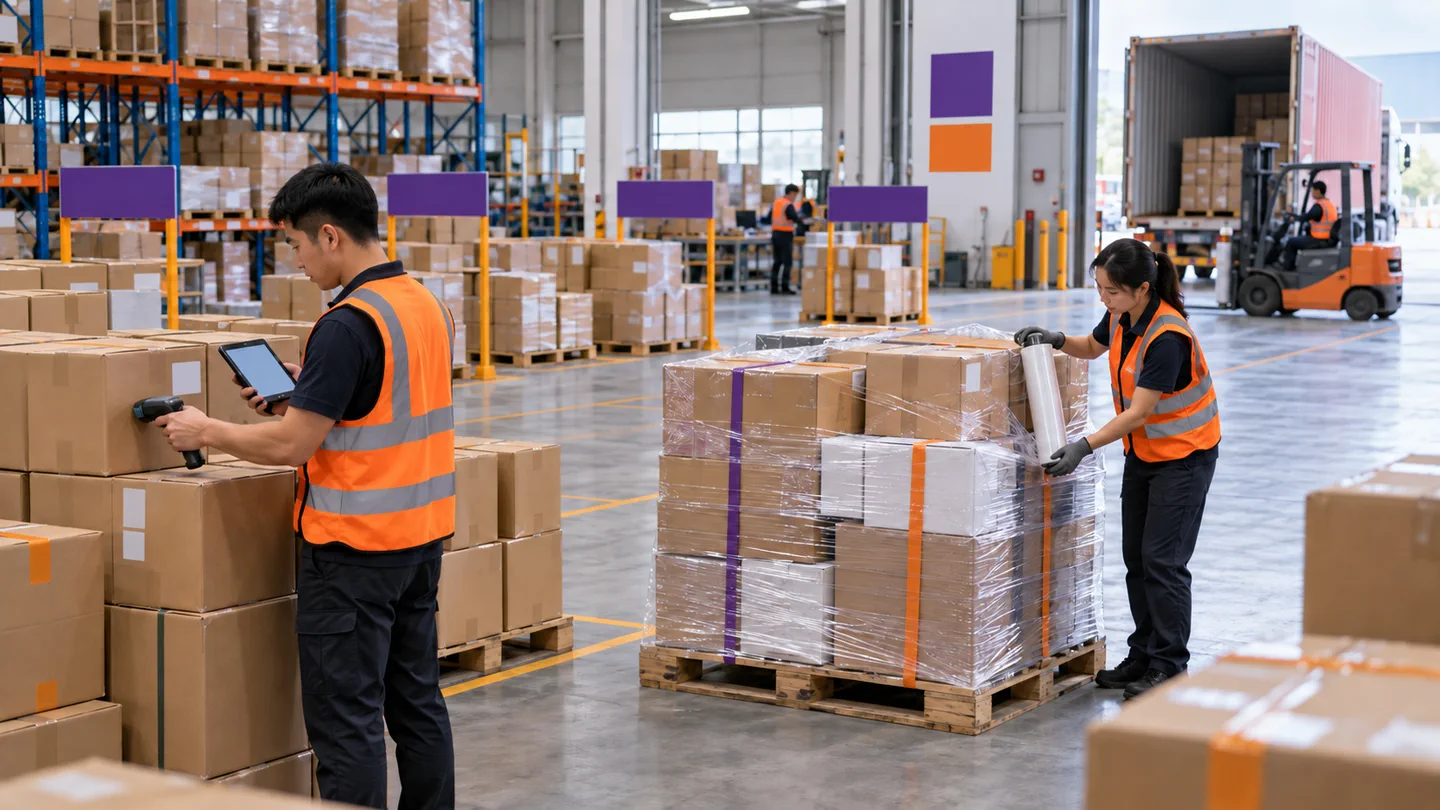
Consolidation is not automatically cheaper in every case. Compare the extra domestic transport and warehouse handling with the savings from a combined shipment. Also confirm that products with special handling, batteries, liquids or regulatory controls can legally travel together.
9. Plan shipping and customs clearance
Choose transport according to cargo size, urgency, value and product restrictions. Courier or air freight may suit samples and urgent lightweight goods. Sea freight is usually considered for larger commercial shipments, while rail or truck options depend on the route.
Clarify the Incoterm in writing. EXW, FOB, CIF and DDP allocate costs and responsibilities differently; they are not interchangeable price labels. Ask your forwarder which charges are included at origin, in transit and at destination. A low ocean-freight quote may exclude terminal handling, documentation, customs clearance or delivery.
Before departure, check the commercial invoice, packing list, bill of lading or air waybill, origin marking and product-specific documents. For U.S. entries, CBP explains that the commercial invoice value is generally based on the price paid for the goods, with certain additions that must be declared. Your broker should review the documents before the cargo arrives.
10. Start with a controlled first order
A first order should validate the supplier, specification, packaging, transit protection and customer response. Avoid increasing volume only to reach the lowest price tier if it creates excessive inventory risk. A smaller, well-controlled order can provide better information for the next purchase.
After delivery, record actual landed cost, defect rate, delivery time and customer feedback. Use those figures to improve the specification and supplier scorecard. Importing becomes more predictable when each order produces data for the next one.
Brief → supplier shortlist → comparable quotations → verification → approved sample → compliance check → purchase order → production control → inspection → consolidation → customs and delivery.
Common mistakes when importing from China
- Buying by photo only: appearance does not define material, performance or dimensions.
- Choosing the lowest quote: an incomplete specification makes prices incomparable.
- Skipping the sample: production begins without a physical quality reference.
- Checking compliance too late: testing or label changes delay finished goods.
- Paying an unrelated account: the beneficiary cannot be matched to the contracted supplier.
- Inspecting after full payment: leverage and correction time are reduced.
- Ignoring landed cost: freight, duty and destination charges erase the unit-price saving.
Frequently asked questions
Can a small business import from China?
Yes. Small businesses can import from China, but the suitable product, MOQ and shipping method matter. Start with a specific buying brief, calculate landed cost and use samples and inspection to reduce the risk of the first order.
Do I need a sourcing agent in China?
Not every order requires one. A sourcing partner is most useful when you need supplier search beyond one marketplace, Chinese-language follow-up, custom packaging, factory coordination, inspection or consolidation across several suppliers.
How do I find reliable Chinese wholesale suppliers?
Shortlist multiple suppliers, compare the same specification, verify registration and payment details, review relevant production capability, request product-specific reports, approve a sample and use a written purchase order with quality requirements.
What is the safest way to pay a Chinese supplier?
Use a traceable business payment method and verify that the beneficiary matches the contracted company or has a documented relationship to it. Payment terms depend on the order, but avoid sending the full production value before the agreed quality and shipping checkpoints.
How long does importing from China take?
The timeline includes sourcing, samples, compliance work, production, inspection and transport. A repeat standard item may move quickly, while custom tooling, testing or sea freight can add weeks. Ask for a milestone schedule rather than one unqualified delivery date.
What information should I send to get a sourcing quotation?
Send the product name, photos or links, material and size, estimated quantity, destination, target price, logo or packaging needs, certifications and desired delivery date. If the brief is incomplete, start with the information available and identify the decisions still needed.